Sunday, November 26, 2006

Rosemary Focaccia--two ways!

Sunday, November 26, 2006
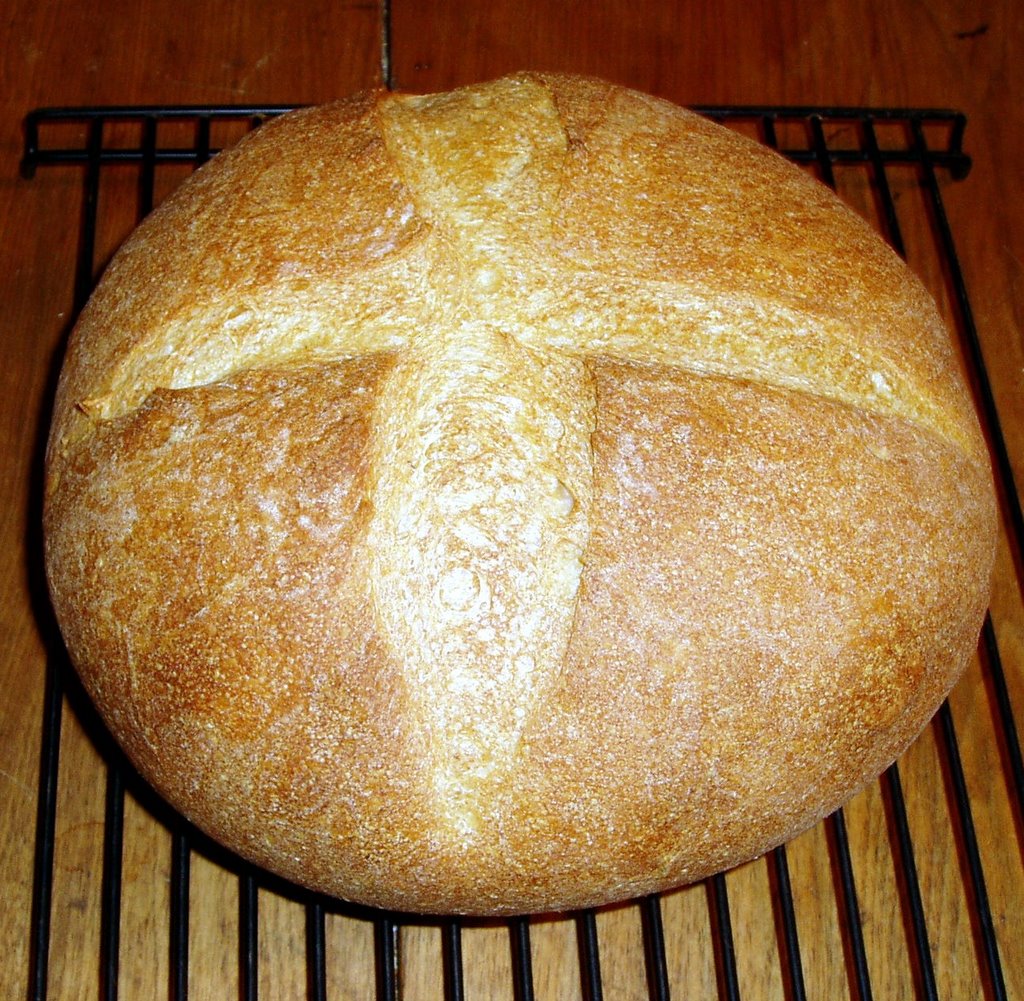
This is not my very last bread--I still have one to make--but it's the only one that has been unsuccessful, so I felt that I had to give it another try. This time it worked. But I can't figure out why this time, both the original focaccia and the variation, with garlic poached in olive oil, were rousing successes and very easy, and the first time nothing went right.
The directions say that the dough will be very soupy, but after beating for about 20 minutes, it will be "transformed into a smooth, shiny ball."
On my first attempt, that transformation never occurred--it just stayed soupy. After about 25 minutes of waiting for the transformation to occur, I added more flour, but it still stayed soupy. I tried baking it anyway, but it never metamorphosized into anything resembling bread.
This failure has galled me for my entire year of baking bread.
Elizabeth was still at home for her Thanksgiving break, and she said she wanted to try her hand at bread baking too, so she opted for the focaccia with pockets of garlic variation. After she heard about my first attempt, she said she would simply use less water. I told her it was supposed to be a very wet dough. She said, "Mom!" (Generally when she says "Mom" with an exclamation mark, it means I've said something stupid.) "Mom! Haven't you ever heard of the scientific method? We'll experiment!" As it turns out, neither of us followed the recipe precisely, but her change was deliberate and mine were accidental. And both methods gave us beautiful bread.
I intended to measure everything with great precision, but, as usually happens when I start baking before I have my full measure of coffee, I made a few errors. I used 3/4 teaspoon of yeast instead of 3/8 because I got confused. And I started pouring in the water before I had even measured it, so I measured out 442 grams (the correct amount) and poured out approximately the same amount that I'd already added to the flour. While I was doing this, I kept telling myself that I should just start over. After all, I'd only be wasting flour and water. But I just kept going. And this time, right on schedule, after 20 minutes of beating, the dough miraculously turned into the shiny, smooth ball.

And, even more miraculously, when I poured it into the dough-rising container, it looked exactly like "melted mozzarella," just as it was supposed to look.

Because I'd doubled the yeast, my dough rose in 2 hours. While I was waiting, I poached the garlic for Elizabeth's bread. The poached garlic is fabulous--even better than roasted garlic because the temperature is easier to control, and the garlic becomes soft and creamy without getting hard and chewy on the outside. And, of course, you're left with garlic-infused olive oil. The only disadvantage is that garlic permeates the air of the entire house, causing both your eyes and your mouth to water.
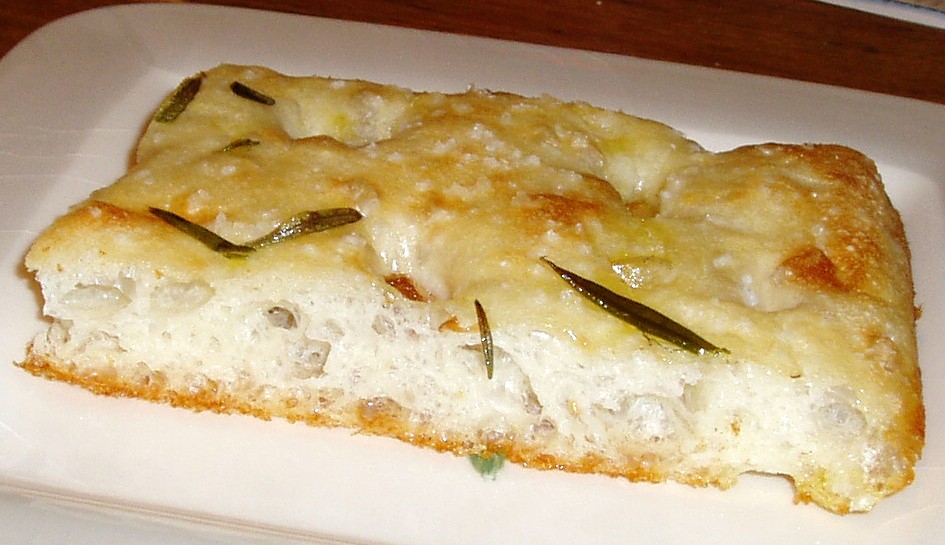
After being baked for just 13 minutes, the stretchy, shiny dough turned into the best focaccia I've ever tasted, and we dug into it immediately. It was crispy, but incredibly light and airy. It was not just bread, it was vindication!

I remembered the testy e-mail I sent to Rose after my first failure, telling her that she should get rid of this recipe in the next edition. NO! Pay no attention to that e-mail! It not only works when you follow the directions, but it also works even when you don't follow directions.

After the three of us greedily ate the rosemary focaccia, the less yeasty dough was ready to receive its garlic. Elizabeth and I made pockets in the dough--hers, like mine, was smooth and very elastic--and worked in the golden bits of garlic. In another 13 minutes, out came another perfect pan of focaccia--and this one was even better than the first.
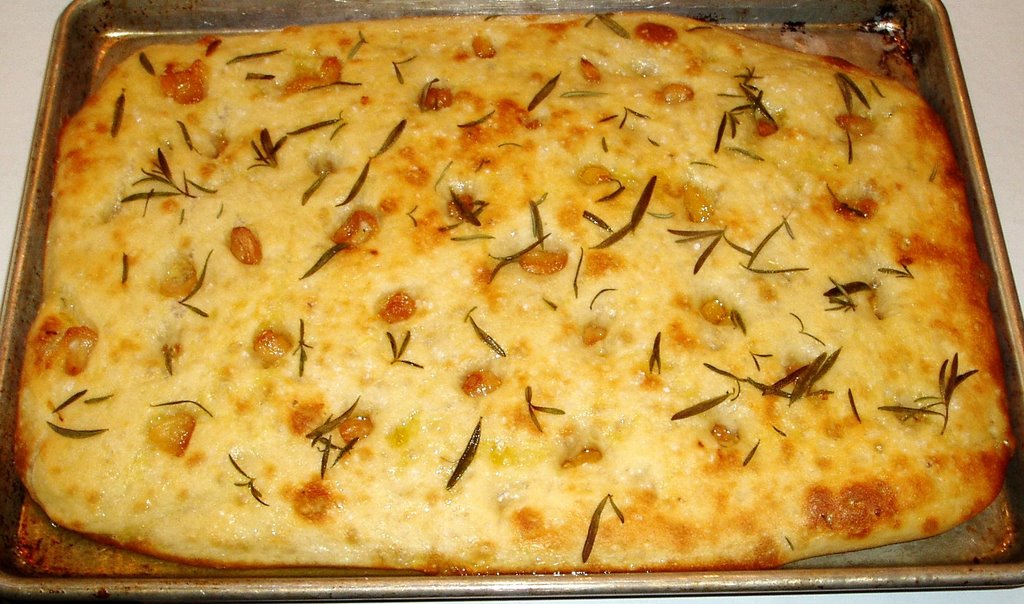
My 82nd bread this year; Elizabeth's first ever. And both of them superb. Thank you, thank you, Rose, for not listening to crotchety people like me and for insisting that this wonderful bread can indeed be baked perfectly.
So what happened? What accounts for the difference? I can think of only a few possibilities. This was my first loaf of bread and I used flour that I'd had on hand. Because I didn't do that much baking, my flour might have been middle-aged if not elderly. This time, I opened a brand new package of King Arthur all-purpose flour. Or the first time, I was measuring the old-fashioned way: with cups and teaspoons. Now I use a scale and no longer understand why we don't weigh instead of measure in this country. Or it could be my shiny new KitchenAid. But my friend Sara has made this bread without incident many times using her old Artisan model. Finally, I might try to chalk it up to experience, except that Elizabeth's bread turned out as well as mine, and she has no experience at all. (Although she was guided by me, which must be worth something).
If my first description of baking this bread has discouraged anyone from baking this, or if, like me, you've tried and failed, I beg you to pluck up your courage and open The Bread Bible to page 205. You'll be glad you did.

Friday, November 24, 2006

Happy Thanksgiving!


Friday, November 24, 2006
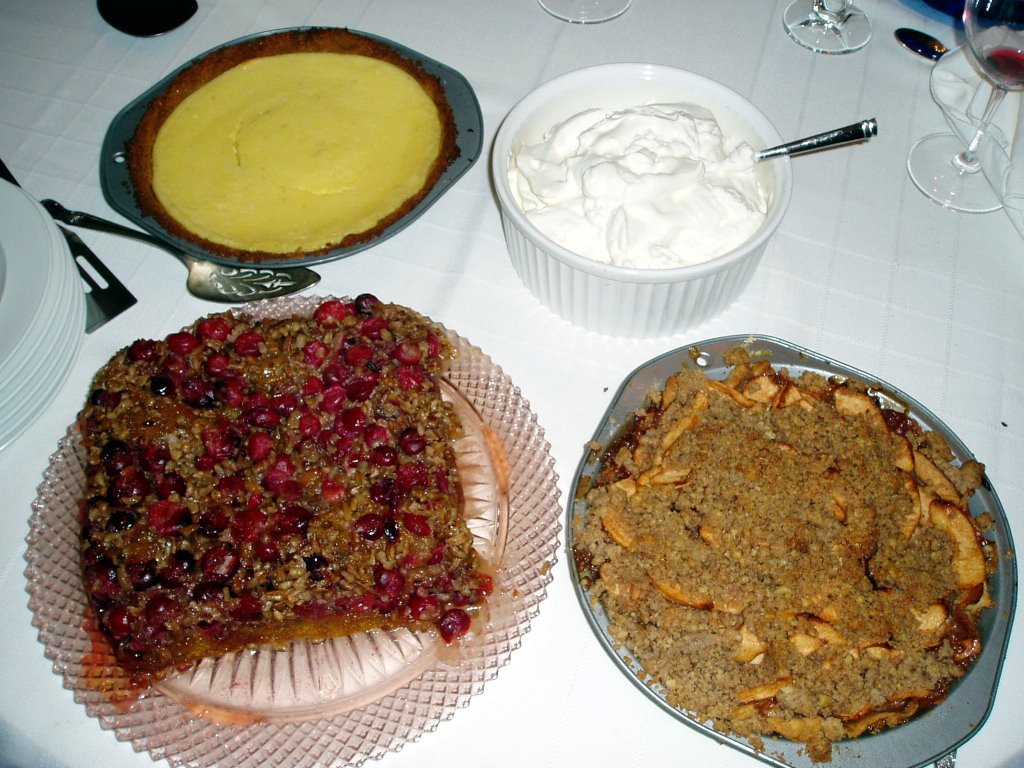
I thought that I might get out of cooking the big Thanksgiving feast this year because I had hoped that our kitchen renovation might be under way. After Michael (Anschel of Otogawa-Anschel) told us that he wouldn't start until January, I gave up and decided just to cook up a storm. My menu was ambitious: roast turkey, mashed potatoes with roasted garlic, sweet potatoes with maple syrup, stuffing with parmesan and pine nuts, cranberry chutney, stir-fried green beans with garlic and ginger, roasted Brussels sprouts, sweet-tart cippoline onions, and Parker House rolls. My daughter Sarah brought a beet and fennel salad, and my daughter Elizabeth made a big green salad. Jim's sister Betty brought shrimp cocktail and a cheese dip with a raspberry-chipotle sauce. For dessert, I made Apple Crumb and Key Lime pies (both from Rose's Pie and Pastry Bible) and a Pumpkin Upside Down Cake from Lynn Rossetto Kaspar's newsletter.
This menu turned out to be not just ambitious, but crazy.
I took Wednesday off work to cook and I started off in a leisurely fashion with the apple pie. I make pie about once a year--on Thanksgiving or Christmas (except on the year that I threw a big Pie, Poetry, and Potables party, but that's a different story)--so my technique is not good. If I decided to throw myself into pie baking in a big way, I would have to experiment with different rolling pins and surfaces, but for now I made do with the one I picked up at Target a few years ago.
For the apple crumb pie, I used Rose's cream cheese pie crust. It was, as promised, both tender and flaky, and it tasted so delicious that you could fill it with cinnamon and sugar, roll it up, and eat it as a little pastry. I know that you could because I did. It brought back memories of childhood, when my mother would always give all of us a scrap of pie dough to shape, fill, and bake, except that this was a tastier crust than my mother made, because she used Crisco instead of butter and cream cheese. However, the crust wanted to stick to the counter, and I didn't leave enough dough on the edge to make a good tall crust. This pie is not a work of art, but it was one of the best apple pies I've ever eaten.
href="http://photos1.blogger.com/x/blogger/169/2232/1600/905004/PB230029.jpg">
By the time I got the apple pie out of the oven, however, it was past noon, and I realized I could no longer work at a leisurely pace, and, besides, I needed to go to the grocery store for more supplies. It was almost 2:00 before I started work, simultaneously, on the butter-topped rolls and the Key Lime pie. Fortunately, the Key Lime pie was quick. I've made Key Lime before with bottled Key Lime juice. Although it claims to have no preservatives, it has a nasty taste. Rose recommends solving that problem by using regular supermarket limes instead of Key limes, and this turned out to be a good suggestion. With a little bit of lime zest, it was tart, and, piled with whipped cream, just sweet enough to offset the tartness. Rose's recipe calls for an Italian meringue, which would have been prettier, but we're a whipped cream family. I intended to make a stabilized whipped cream so I could cover the entire pie with cream, and I intended to garnish it with a few paper-thin lime slices, but by the time I served dessert, I was too tired to care, so I just had a big bowl of whipped cream, with an option for vanilla ice cream, for all the desserts.

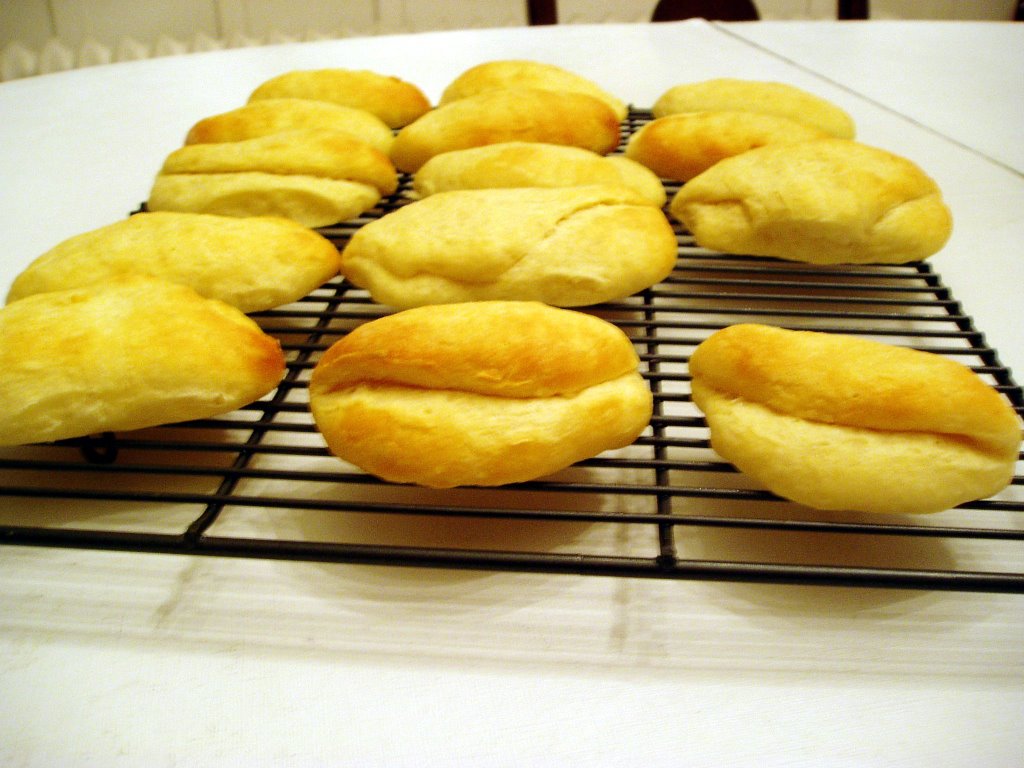
Compared to the pies, the rolls were a breeze. I made the butter-topped roll recipe again, but this time I made Parker House rolls. These are the perfect dinner rolls, and they also make a super-delicious base for a leftover turkey sandwich.

By the time I finished making everything I had to make ahead of time, it was 10:00 on Wednesday night, I was bone-tired, covered with flour, and feeling more put upon than thankful.
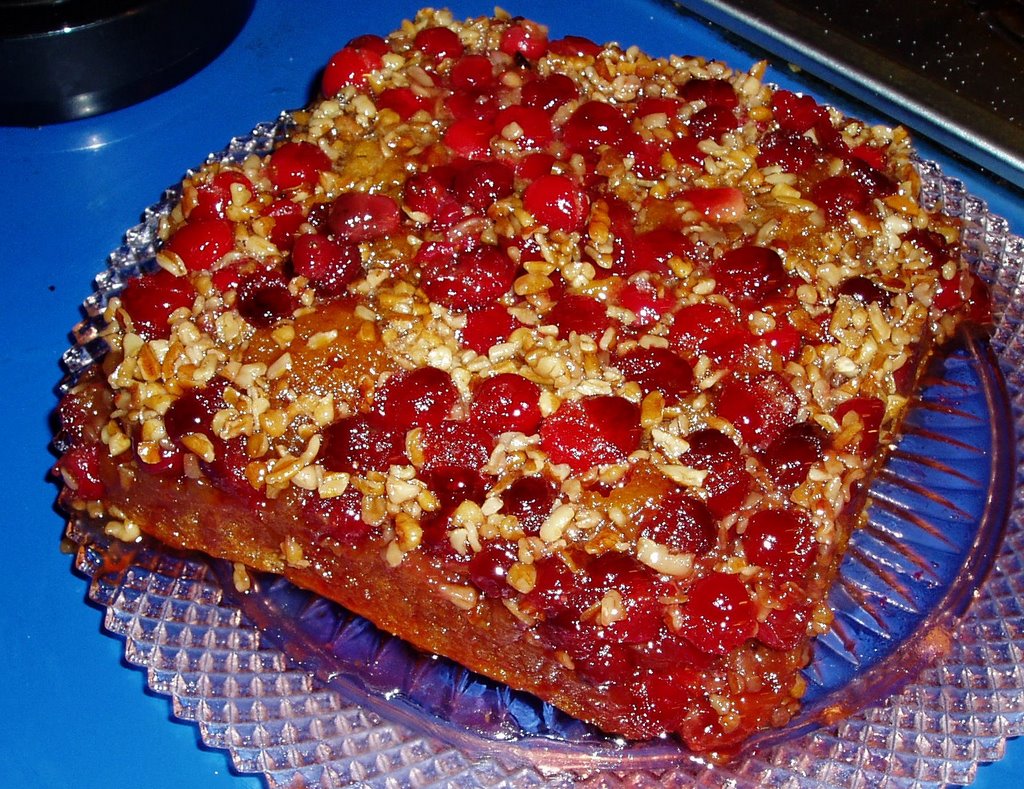
My big question to myself in the days before Thanksgiving: should I bake three pies or should I be daring and make one dessert that's not a pie. This was not an insignificant issue. To present a non-pie option on Thanksgiving would be a serious break from Tradition. I found a recipe for pumpkin upside-down cake with cranberries and pecans that sounded so rich and buttery I thought it would might satisfy pumpkin pie lovers.

Actually, this dessert was a hit, although I was disappointed in it. The butter and brown sugar topping had 8 ounces of butter. I was thinking 8 tablespoons, or one stick, but then I realized that 8 ounces is a half a pound. Half a pound of butter! No wonder it sounded rich. I still wonder if that was a misprint, because there was so much butter that it oozed out of the cake for about an hour until it stabilized. And the texture of the cake was more like a pudding than a cake, but it did look pretty.
Thanksgiving was my family's favorite holiday because it's all about eating, and eating a lot. As a child, I remember eating seconds and thirds, especially of mashed potatoes and stuffing. Now I'm more circumspect, and I eat more vegetables and less gravy, but there is something admirable about a holiday that doesn't force you to buy presents--just to eat. And there is something very sweet about the Midwestern way of saying thank you--"Oh, you fussed! You shouldn't have!"

Monday, November 20, 2006

Heart of Wheat Bread


Sunday, November 19, 2006
This is the easiest bread ever--it's hardly any more trouble than going to the grocery store and buying a loaf of bread. And that's only a slight exaggeration. Its ingredients are just bread flour (I still had some King Arthur Artisan Flour that I bought for baguettes, so I used that), yeast, water, salt, a little honey and a few spoons of wheat germ: the virtues of whole wheat and the virtues of white, all in the same loaf. You make the sponge, ignore it for a few hours, turn it, ignore it, shape it into a free-form loaf, ignore it once again, and bake it. It's crusty and wheaty, with a wonderful texture, and it can easily be made in the space of a day.


We had tickets for The Rivals last night, and our friends June and David Miller came over for a quick dinner before the play. The bread, still warm from the oven, was the star of the appetizer table. This morning, I had it for breakfast toast, and it was as good as toast as I was hoping it would be. Rose says that this bread is the culmination of everything she learned about baking bread.
Although The Bread Bible has some elaborate and complex recipes in it, it's interesting that this bread--a summary of Rose's extensive knowledge about bread-baking--is such a basic, simple bread. But have you ever noticed that most chefs say that their favorite recipe, and the one they've worked the hardest to perfect, is roast chicken? To do something simple, and to do it perfectly, must be the mark of the expert.
Maybe I can't claim perfection for my first try at Heart of Wheat bread, but I can claim pretty damn good.

Tuesday, November 14, 2006

Panettone

Tuesday, November 14, 2006
I had volunteered to bring bread to my Tuesday night book club and was trying to figure out how I could bake a bread on Tuesday and still go to work, having decided that I was not going to do Bring Your Bread to Work Day again. I looked at the recipes for the three remaining breads I had and decided that panettone would work well because the recipe allows for many hours of optional refrigerator time.
On Saturday, we went to Trader Joe's and got some chestnuts and a nice raisin medley. I had already ordered the Fiori di Sicilia--the essential flavoring for the bread, and the decorative paper breadpans, so I was all ready (except for the orange, which I forgot and had to send Jim out to fetch early Sunday morning). And, by the way, Jim is perfectly happy in his role of fetcher of forgotten ingredients for, as well as eater and photographer of bread.
I made the sponge on Saturday night, mixed the dough, let it rise, and shaped it on Sunday, and then put it in the refrigerator. I left careful instructions for Jim, who was working from home today: take dough out of refrigerator at noon and call me when it has risen up to the top of the paper pan. When I called him at 3:00 to check on its progress, he said it was still 3 to 4 inches below the top. I told him how to improvise a proofing box and then worried about why my poor bread was being so slow when it had been lustily rising away two days earlier. I fretted so much I decided I might as well just leave work early to check on it. Although Jim had concocted an excellent makeshift proofing box, the bread was still below the top of the bread pan. Still, it looked very pretty and puffy so I just hoped it would all turn out all right, which, in fact, it did, and it was still warm when I toted it to book club.
alt="" />
I honestly wasn't that keen on making panettone. We got one last year from Harry and David and, while it was not disgusting, it wasn't anything to write home about. In fact, I ended up taking half of it into work where they eat anything. But--sorry Harry and David--this bread is so far superior to what I got last year, it shouldn't even share the same name. It's rich, buttery and feather-light, with a hint of sweetness and a wonderful citrusy tang, and just the right amount of raisins. If I owned the above-named mail order company, I think I would think hard about changing my panettone recipe to, say, this one.

Friday, November 10, 2006

Wheaten Croissants


Friday, November 10, 2006
I just couldn't allow the croissant to be my very last bread. The very idea of actually baking a croissant on my own was causing me far too much consternation. I got the day off today, and, while a French roll is perhaps not the most appropriate thing to make for Veterans' Day, the French were, after all, our allies in two world wars, so it wasn't completely off the wall.
I mixed up the dough last night. That part was easy. This morning, after a big mug of strong coffee, I was ready to tackle the butter package and to start the process of rolling the butter into the dough. You know what? It really wasn't that hard. As I rolled, folded, refrigerated, rolled..., I forgot my fear and just concentrated on the project at hand. In that respect, it was a little like labor, where you become so focused on what you're doing, you have no time to worry. (Lest the labor analogy scare anyone, I want to assure you that in no other way is making croissants like labor, except the finished product makes it all worthwhile).
My big worry was that the butter would break through the dough and make the whole thing a big mess. That didn't happen. I also wasn't quite sure that I could follow all the detailed instructions, but I did--and it would be much easier next time.
The only problem was that I didn't let the rolls rise enough. My friend Teddie planned to drop by today with her daughter, Clea, and I promised her a fresh-from-the-oven croissant at 4:30. I started the rising process at 1:30, so I thought they should be ready to go into the oven at 3:30, making the timing just about perfect. At 3:30, they hadn't doubled in size yet, so I put them in a warmer place for another 20 minutes. They still hadn't doubled, but I put them in the oven anyway. And I ended up making 14 instead of 12 because that's the way the triangles turned out. Consequently, the croissants were a little smaller than I'd envisioned.
I took them out of the oven just as Teddie and Clea walked in the front door and Jim walked in the back door. The house smelled heavenly, and I doled out the croissants like Lady Bountiful herself.

Teddie, Clea, and Jim ate theirs plain, and I put orange marmalade on mine.

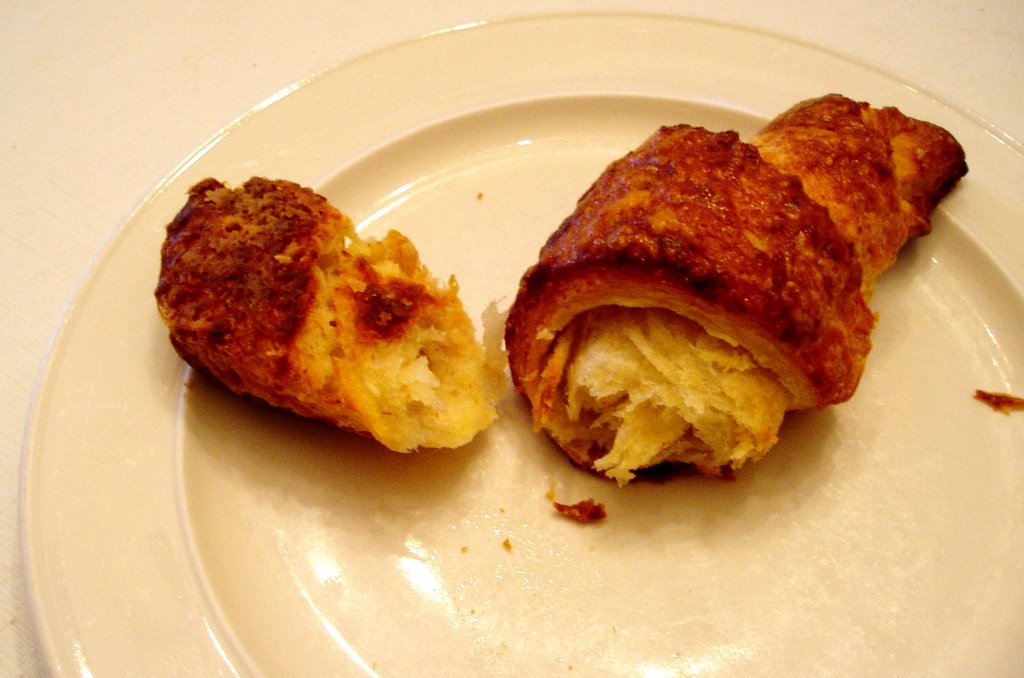
Perhaps they were not quite perfect, but they were delicious, with a crusty exterior and an inside that was all flaky tenderness.

I don't know what French cook got the idea to take a big chunk of butter and work it into buttery layers, but whoever it was deserves a Medal of Honor. Or the Croix de Guerre. Or the Croix de Croissants.
Jim said, "Don't you feel proud of yourself?" Well, yes I do. But what I really want to do is to make them again in my new oven that will have a bread proofing setting and that will, I hope, not be anywhere from 25 to 75 degrees off. If only I had had the foresight to include baking croissants on my list of life goals, I could now cross it off!

Sunday, November 05, 2006

Authentic Pumpernickel Bread


Sunday, November 5, 2006
I didn't think there would be any bread this weekend, but I got home in enough time to make pumpernickel bread, which, of the five I have left, was the one that took the least amount of time.
Because we are public defenders, and our budget is always tight, our annual conference is at the cheapest resort in Minnesota on the cheapest weekend of the year. The first weekend in November is off-off-season for northern Minnesota. The only other thing that's going on is Deer Opener; that is, the first day that people can go out in the woods and commune with Nature by killing animals.
We have a very close-knit office, and everyone was looking forward to going to Cragun's (the cheap resort), even though everyone always complains about the decor (ratty North Woods), color scheme (turquoise and brown), the smell of the cabins (combination of mildew and bleach), and the food (all-you-can-eat bowls of lime jello with pineapple tidbits and miniature marshmallows). As soon as we got there, people started talking about when they were leaving. The young women who were spending their first time away from their babies made secret phone calls to their husbands to check on whether their husbands had remembered 1) to pick up the child from day care and 2) to feed him or her. (All was well). The somewhat older women told the new mothers to enjoy their time away from their kids because it wouldn't happen very often. And some people (well, one person) kept talking about a KitchenAid and bread. The men, on the other hand, started drinking beer as soon as they arrived and showed no interest in going home early.
I stayed until Sunday morning, skipped the last two classes, and headed for home--the KitchenAid and The Bread Bible.
What a machine this is! Well, I have to admit that I was a little confused at first, but it didn't take me long to figure out how to attach the bowl to the mixer and to move the bowl up and down. My only real dilemma was the mixer speed: Rose says to knead on #4, but KitchenAid has dire warnings on every available surface of the machine, on the bread hook itself, and repeatedly throughout the informational brochure: "Use Speed 2 to mix or knead yeast doughs. Use of any other speed creates high potential for unit failure!" I finally decided I'd better go with KitchenAid's warnings, since Rose didn't threaten me with anything as bad as "unit failure" if I didn't use Speed 4.
It must be a more powerful motor because #2 speed worked just fine.
When I made the sourdough pumpernickel bread a month or so ago, I didn't have the caramel color and I had only very coarse sourdough grain. It still tasted good. I think that this one may have been even better. I liked the texture of the more finely ground flour, and the caramel color, along with the cocoa and the instant espresso powder, deepened the color beautifully. I added a little sourdough starter to the dough while I was mixing it, and that small amount of sourdough, plus a little cider vinegar, gave the bread a subtle tang.
I had two minor mishaps, but neither one shows in the picture, and neither one affected the taste. La Cloche slid into one side of the bread when I put it in the oven, so that side stuck to La Cloche and had to be forcibly detached. But we just moved that side to the back for the photos. And I made a mistake about the baking time so I took the bread out too early; even using the "thump" method instead of the thermometer method, however, I could see it wasn't done, so I just put it back in. And what's a project without a mistake or two?

Wednesday, November 01, 2006

My New KitchenAid

Wednesday, November 1, 2006
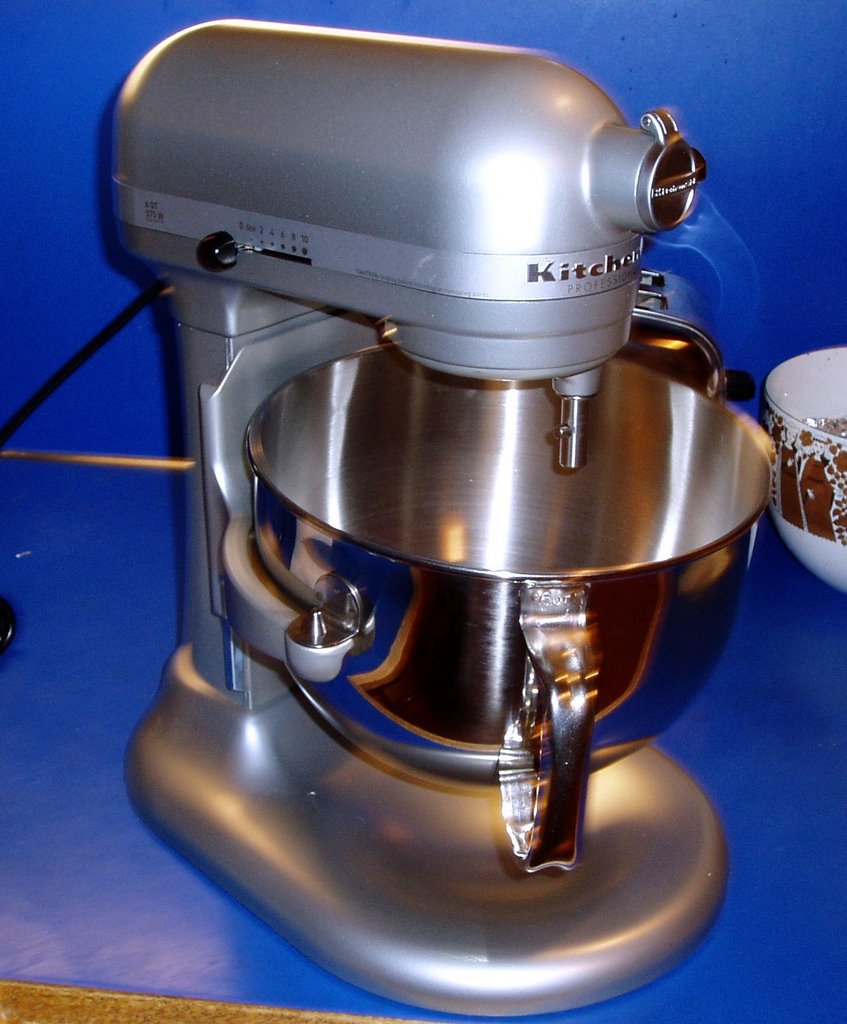
This morning, just before I was going out the door to go to work, a FedEx truck drove up and handed me a large box. Actually, he didn't hand it to me, he brought it in and put it on the floor. It said "KitchenAid Professional 600 Series, Nickel Pearl." My dream machine in my dream color.

It seems that Rose Levy Beranbaum and the friendly KitchenAid people were worried about my old mixer (the one that was left in Blaine and may have been kidnapped for all I know because I still haven't heard a word about it) and about the dwindling amount of time left for my project and the slightly hysterical tone that seems to have crept into my writing when I talk about said dwindling time. So they decided that it would be a very good thing if I had a brand new KitchenAid that would purr like a kitten when I was turning out my remaining five breads. And who am I to disagree with my highly distinguished, generous and thoughtful Bread Mentor and kindly Mr. KitchenAid.
When I got home from work, I took everything out of the box and admired its sturdiness and its techno-charm.

My friend Karen called to remind me that it's Wednesday--yoga night--but I demurred. "I want to sit home and gaze lovingly at my new KitchenAid, and I need to read the instruction manual so I'm all ready to bake," I told her.

Finally she bribed me by promising to pick me up and to turn on the heated leather seats in her car and to buy me a glass of wine when we're done with yoga. I succumbed to her blandishments.
The really irritating thing is that I have to leave town on Friday for the annual 3-day Public Defenders' Conference, and, unless I can sneak away early, I'm not going to be able to bake any bread this weekend. It's so annoying how people think they can tell you how to spend your day just because they pay you a salary.

Sunday, October 29, 2006

New Zealand Almond and Fig Bread


Sunday, October 29, 2006
Another bread that I kneaded by hand instead of by mixer. It's been two weeks now--the promised repair time--and I'm still KitchenAid-less. I am getting better at kneading by hand, though, and today I managed to be downright stingy with the amount of extra flour I kneaded in.
When I first paged through The Bread Bible, this bread looked too fancy for me, with the figs, the two kinds of almonds, and the apricot glaze. The figs especially worried me, because it's hard to get fresh figs in flyover land. On a closer reading, however, I realized that all I needed was dried figs, which are really not that much fancier than raisins. And the two kinds of almonds were hardly exotic--sliced and slivered. And the apricot glaze was just apricot preserves and water. I can handle that.

This bread is made with a combination of bread and whole wheat flours, which is a winning combination, providing a sturdier, more flavorful crumb than you get with all-purpose flour. The almonds add a satisfying crunch and the figs marry perfectly with the almonds. I wondered if the apricot glaze would be gilding the lily--just one step too many. But it turned out to add just a hint of additional sweetness and a beautiful shine. We each had more than one piece, served with Maytag blue, this afternoon, along with cappuccino. (No wine for me this afternoon--I'm working on an oral argument for tomorrow morning at the Minnesota Supreme Court, and I need all the lucidity I can muster).
I have only five breads left to make--and one of them is the most fearful of them all--the croissant. I can't put it off much longer.

Saturday, October 28, 2006

Low-Salt Tuscan Bread


Saturday, October 28, 2006
Since the last bread I made was (unintentionally) salt-free, I figured that I might just as well move on to intentional low-salt bread. I have to admit that I am not a big fan of many Italian breads. We have had fabulous foods in Italy, and found that you can stop in almost any restaurant or cafe, no matter how modest (even a highway rest stop!), and get something superb to eat. That high quality didn't extend to their breads. When I got home from my first trip to Italy, I did a little research and discovered that the problem, from my perspective, was that traditional breads often didn't use salt because, thousands of years ago, salt was too expensive to waste on ordinary bread. Then, when salt became as common as dirt, apparently Italian palates had grown to adjust to rather tasteless bread. This bread isn't totally saltless, but has just a half-teaspoon.
As I read the recipe, I realized that this is one of the very few in Rose's book that doesn't give alternative instructions for mixing by machine and mixing by hand. But I had already decided that this was the next bread on my list, and I was not going to change just because hand-kneading might not work. What about all those Italian ladies from the 15th century who didn't have KitchenAids? Surely they still made bread! I vowed to follow in their footsteps.
I decided that I would try my hand mixer to see what happened. It is soon very clear that this is not going to work. The dough just wound its way up the beaters and became a mass at the top of them. I scraped every bit of dough off, and started kneading. Hmm. This is very sticky dough. After five minutes of kneading, trying not to add much more flour, the dough is about one-fourth stuck to the counter and three-fourths stuck to my hands. I carefully pull it off both places and let it rest. After a 20-minute nap, it's much more tractable.
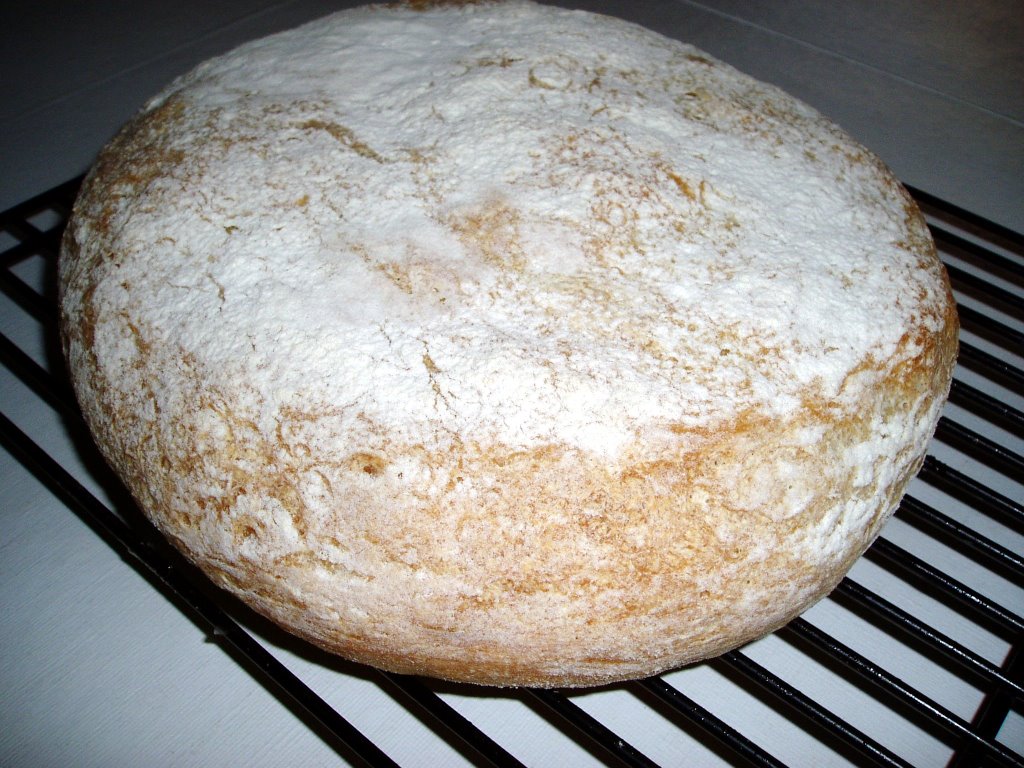
I love how you shape this bread! You just dump it from its rising bowl onto a parchment-lined baking sheet. I wonder why you can't do this with all breads because it's the easiest thing ever. It bakes into a nice round disk, and, although I have no idea how it's supposed to look, it looks fine to me.

And, as it turns out, it tastes fine too. We shared it with some neighbors, and served it with some excellent wine that Elizabeth bought Jim for Christmas, as well as with olive oil, Maytag blue cheese, and Tuscan salami. The bread was chewy and crusty, and excellent with each accompaniment. After tasting the bread with cheese, salami, and oil, I tasted it alone. Even without a bold-tasting partner, the bread is flavorful and delicious--it did not taste as if it was missing something at all, so perhaps this small amount of salt is all that's necessary to make it taste like bread, and not baked flour. I recommend this bread highly--it's simple to make, it's tasty, and it's attractive. It is the Italian equivalent of a baguette, except it's much easier to make.

Thursday, October 26, 2006

Cheddar Loaf


Tuesday, October 24, 2006
My neighbor Laurel invited me for a dinner party on Tuesday, and, when I asked if I could bring anything, said, "How about a loaf of your good bread?" Well, when she put it that way, I couldn't say no.
As Evil Cake Lady (who really does not seem to be at all evil) reminded me, breads can actually be made without mixers, and I am ready to knead away by hand until my KitchenAid is returned to me.
But the problem here was not the mixer so much--it was time. I had a party at my house on Monday, and I had to go to work on Tuesday. I spent a lot of time pondering this question, and finally decided to make the bread at work. Yes..it would be National Take Your Bread to Work Day!
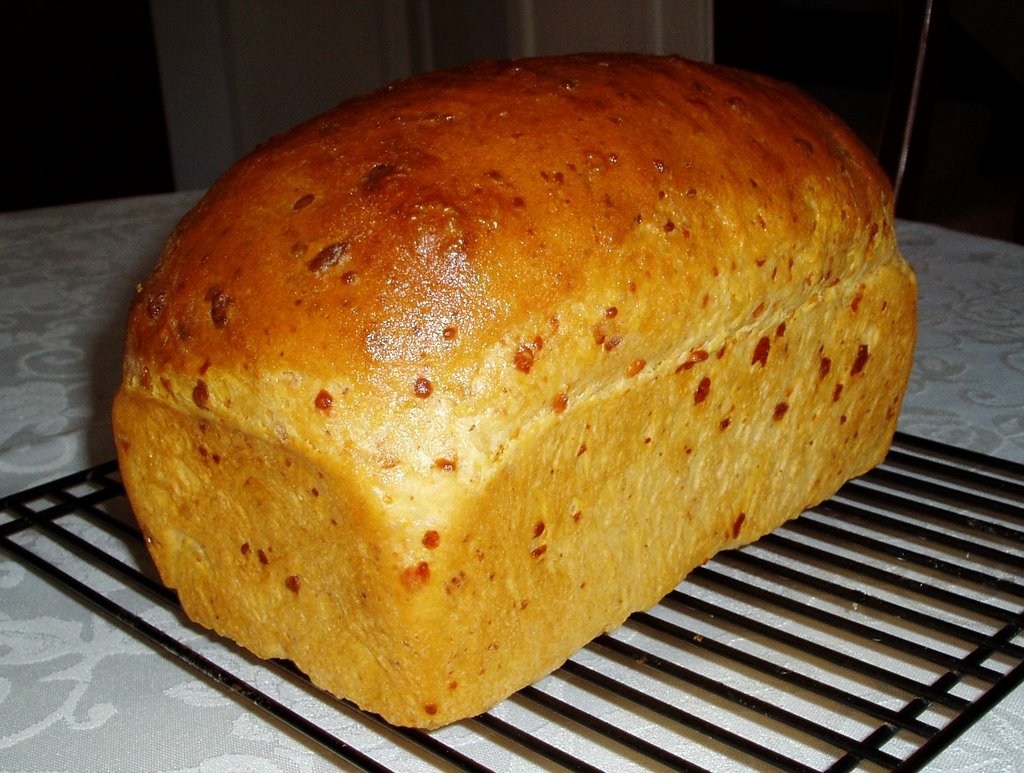
After I got rid of my guests on Monday night, I mixed the sponge and let it sit out for an hour, then put it in the refrigerator while I slept. The next morning, I added the cheese, mustard, and cayenne to the basic white dough recipe and put it in my dough rising container. Then I gathered up everything else I needed and sped to work in time for an 8:15 meeting. By 9:30, the dough was ready to be turned out and shaped. My friend Susan, who is the kind of person who watches every TV special about the alarming number of germs found in hotel rooms, yelled at me: "You can't put that dough on that table! It's disgusting!"
"Ha!" said I. "I'm way ahead of you. I brought in my disinfecting cleaner." "You can't use that gross office dishcloth," she warned. "This is my own perfectly clean dishcloth." "Your bread will taste like disinfectant!" "I brought in a second clean dishcloth to wipe the disinfectant off." Oh, I was pleased with myself for thinking of everything.
At 11:00, the dough had doubled again, and was ready to be put in the loaf pan, which I had, of course, brought--because I thought of everything--and covered with oiled plastic wrap--did I mention I thought of everything. The bread was really rising very nicely because at the end of October, my office is considerably warmer, and much less drafty, than my house.
At 12:30, I drove my loaf pan home and put it in the oven. The cheese-flecked dough was an inch above the top of the pan, and it looked great. By 1:45, the bread was done (it looked perfect), and I went back to work for our monthly office birthday party.
Yet the bread was not quite as perfect as I had thought. When I tasted it, at the dinner party, I got a puzzled frown on my face. Not a frown of disgust, just puzzlement....something wasn't right. I was puzzled enough that I went back over the recipe and suddenly realized that I'd forgotten the salt! You really wouldn't think that forgetting a teaspoon of one ingredient would be enough to make you frown.
And, to make matters worse, I had brought along unsalted butter to the party for the bread. Fortunately, there were a lot of highly flavored ingredients in this bread, so the lack of salt didn't make it bland--just not perfect.
This is what happens when you try to read a recipe and mix something up at 6:15 a.m. after having had only half a cup of coffee. Or maybe I shouldn't blame the coffee. Maybe I should chalk it up to getting my just deserts for being so smug about being Wonder Woman. She's never late for meetings! She whips up amazing breads while writing briefs! She always has everything under control! Not.

Sunday, October 22, 2006

Sweet potato biscuits


Sunday, October 22, 2006
I bought a set of graduated biscuit cutters yesterday. This is the first time I've had an actual biscuit cutter--I've always used a glass or a cup or whatever I have on hand. I'm so happy that I broke down and bought the biscuit cutters, though--their sharp steel sides cut right into the dough so you don't have to twist and turn. I was burbling about how thrilled I was to have actual biscuit cutters at Williams-Sonoma, and the woman who was waiting on me didn't look at me like I was insane. She looked pleased. That is why I like kitchen stores. In fact, I remember being at Williams-Sonoma the day after Julia Child died. At work, I'd been talking about how sad I was and that if I had to name a true hero of mine, it would be Julia Child. The youngsters didn't quite get it. But at Williams-Sonoma, everyone was talking about Julia Child and their sadness at her death.
Anyway, mostly I have made it a point to try to follow these recipes as closely as possible because I feel that one should not go off on a frolic and detour while learning to bake bread. ("Frolic and detour" is actually a legal term of art--about the only one that's fun to say). However, because I am planning to serve these biscuits at a party tomorrow night, and I wanted to be able to taste them myself, I one-and-a-halfed the recipe. Also, because I plan to serve miniature ham-and-biscuit sandwiches tomorrow, I used the tiniest biscuit cutter instead of the standard size.
These are fine, fine biscuits. Like the Angel Light biscuits that I made this summer, these have yeast in them, making them tall and extremely light. I had one plain, one with butter, one with chicken, and one with jam. I would be hard-pressed to say which one was better, and I haven't even tried the ones with ham and honey mustard that I'm serving tomorrow, per Rose's suggestion.
I was sorry that I hadn't brought some White Lily self-rising flour back home with me from North Carolina. I used self-rising flour, but it was General Mills, not White Lily, and it just doesn't have that same deep South cachet.
Now I'm done with the breads that don't require a mixer, and still no word on when my KitchenAid will be done. I've also been asked to bring bread to a potluck dinner on Tuesday, but I may have to (gasp) buy some.

Saturday, October 21, 2006

Dutch Baby

Saturday, October 21, 2006
My KitchenAid is still in the appliance repair shop in Blaine, so I'm trying to bake breads that don't need a mixer until it's back home. After this one, however, there is only one recipe that wouldn't benefit from a mixer. After that, I'll just have to knead by hand. My deadline is closer than I had thought because our kitchen remodel is scheduled to start sometime in early to late November. I may have to take a few vacation days and go into bread-a-day mode soon.
I first saw a Dutch Baby at the Pannekoeken Huis, which our children loved to go to when they were young. The waitresses, wearing wooden clogs, would run out of the restaurant kitchen, yelling "pannekoeken!" The idea was to try to get to the table before the Dutch Baby collapsed. To this day, my older daughter goes into gales of laughter if someone yells "Pannekoeken!" (As you might imagine, this is not an everyday occurrence).
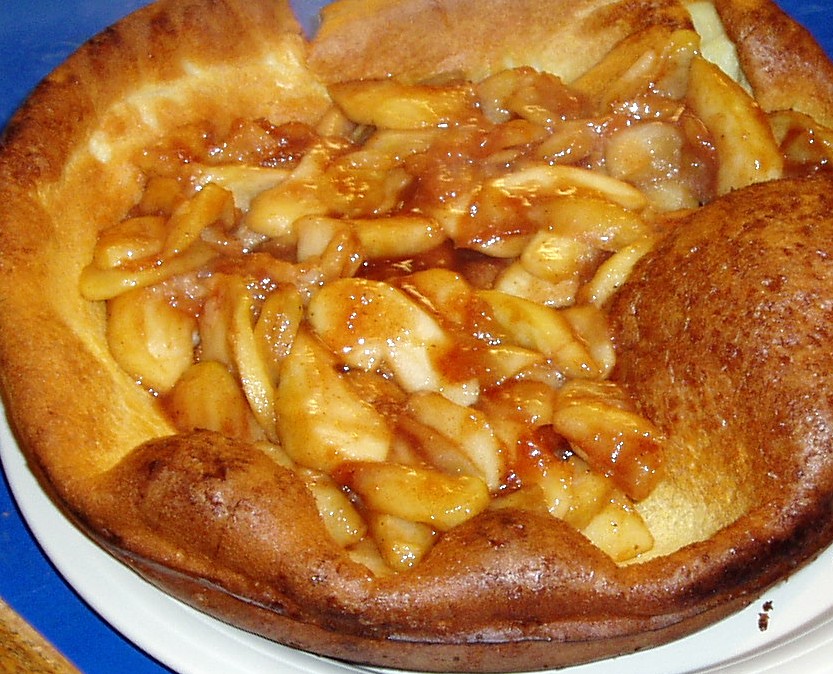
Then I started baking Dutch Babies, and it became the centerpiece of our traditional Christmas breakfast. The ones I baked were good, but not nearly as good as this version. The recipes I've used before are very eggy--basically they were eggs, a little flour, and a little sugar. Rose's version is more time-consuming, and much more delicious. It's got more flour and milk, plus two whole eggs and two egg whites. While the crust is crisp, the entire pancake, including the crunchy crust, is almost meltingly tender.
I bought a special Dutch Baby pan, and this was its maiden voyage. The baby comes out of the oven perfectly puffed.

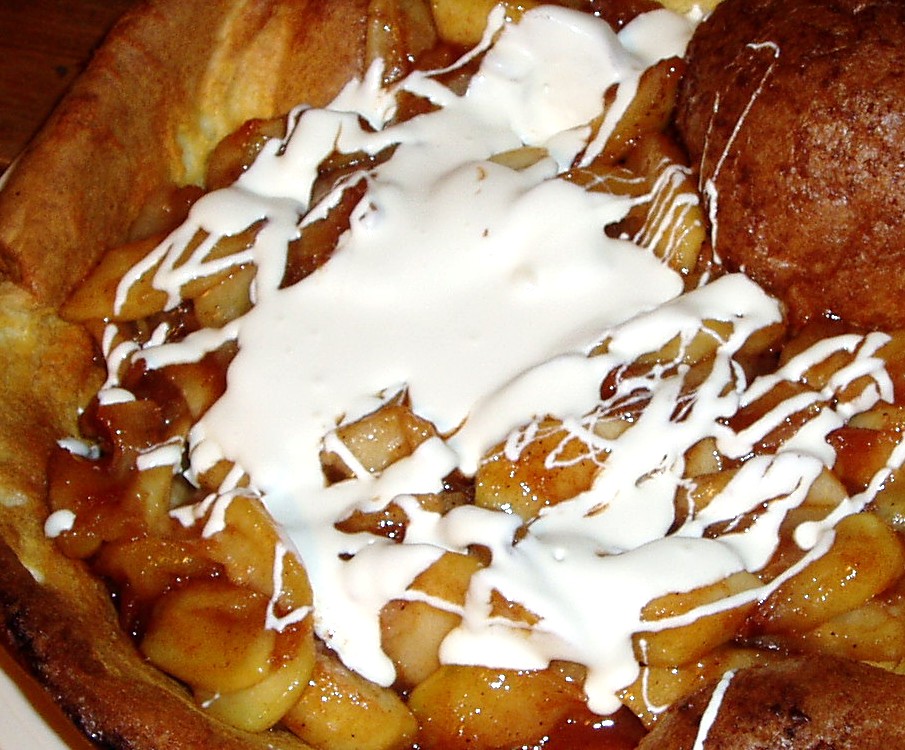
Then you quickly transfer it to a plate, and fill the center with sliced apples that you've cooked with butter, brown and white sugars, cinnamon and nutmeg. (You may notice that this is the second week running that I've made an apple bread. What tastes better in October than apples?)

Then you drizzle some creme fraiche over the whole thing, and happily sit down to eat.

We have more than half of this big Dutch Baby left. It should serve as a hearty breakfast tomorrow morning.

Sunday, October 15, 2006

Cinnamon Crumb Surprise

Sunday, October 15, 2006
People are always asking me what bread has been my favorite. I tell them indignantly that I can't answer that--it would be like saying who is my favorite child. Anyway, I can't even remember what breads I've made unless I sit down with a list, in which case I'm very impressed with myself, if I do say so.
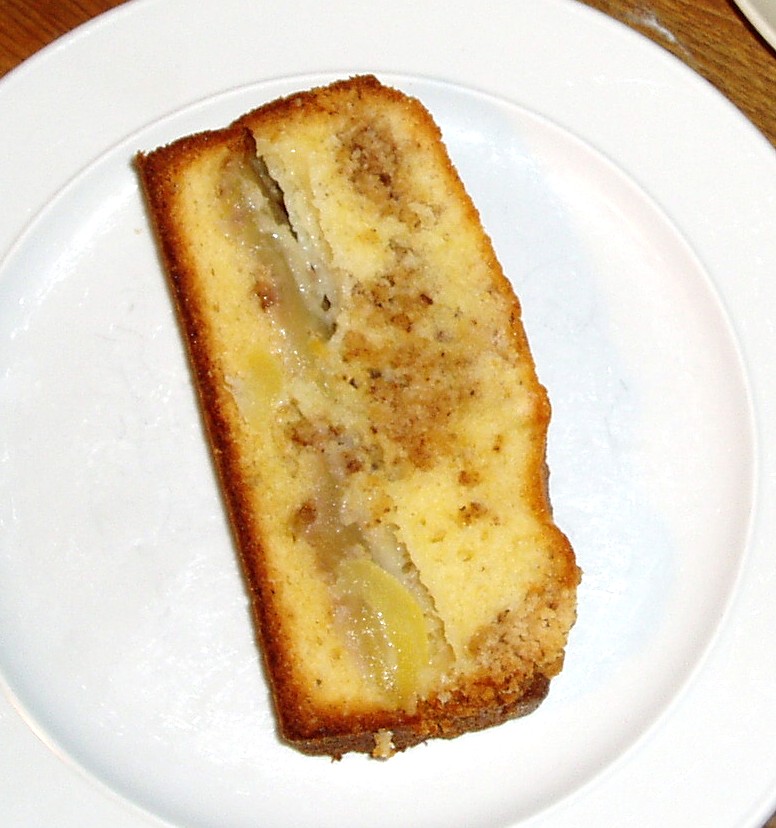
But this lovely quick bread, which is really more like an apple cake, might make it on my Top Ten list.

This is not a difficult bread to make, but it's fairly time-consuming. I expected to have it ready for a mid-afternoon tea at 3:00, but it was more like 5:00 when we ate it. Not that there's anything wrong with a 5:00 tea.
I had most of the mixing bowls I owned filled up with something--the dry ingredients, the egg and sour cream mixture, the crumble, the sliced apples, the nut-and-sugar mix, so the kitchen was a mess when I was done. And by the time I cleaned up, it was ready to take out of the oven.

Then came another challenging step. First you had to let it cool for ten minutes, then invert it on a flat plate on which you've put a clean cotton towel covered with oiled plastic wrap.

I wasn't sure what would happen after I removed the pan. If all went well, it would just lift off, revealing a lovely, browned cake. If not, it would be a mess.

What a relief! Now the only step left was to cut slices and eat them. Can you really blame us for eating two pieces?

Saturday, October 14, 2006

Mushroom Bread


Saturday, October 14, 2006

The good news is that I have a working stove. The bad news is that my KitchenAid mixer gave up the ghost just as I was starting to mix the mushroom bread dough and it is now in the Appliance Hospital, from where it should return, assuming that its illness is not fatal, within a few weeks. We had to take it all the way to Blaine, a far northern suburb of Minneapolis, which feels like a foreign country. Instead of the "Impeach Bush" and "Peace Now" signs, which dot the landscape of my cozy south Minneapolis neighborhood, there were "Guns Don't Kill, People Kill" and "If You Don't Speak English, Get the F... Out" bumper stickers. But the people in the repair shop seemed competent and not at all hostile, so it wasn't painful to leave my mixer out in the suburbs.
I hadn't even thought about the possibility of my mixer going kaput. I was only worried about what pan to use for the mushroom bread. Rose recommends a lovely glass bread steamer, but the company that makes it seems to have gone out of business, and I couldn't find another bread steamer to buy. (Don't people in Boston bake steamed bread any more?) As a second choice, she recommends a one-pound coffee can. But I don't buy coffee in cans, and neither does anyone else I know. I hated to buy a can of Folger's just to make this mushroom bread. I did have an empty plum tomato can that I had used a few weeks ago, and I saved that can in case I couldn't come up with anything else.
One day at work when I was complaining about my lack of appropriate baking equipment for this bread, my friend Susan asked me to explain what I wanted. I told her about the bread, and how it was supposed to turn into a mushroom shape as it rose and then as it baked. She asked me if I really felt the need to commemorate North Korea's atomic bomb by making a mushroom-shaped bread. Very funny, I said. But from then on I started to think of this as my Great Leader bread.
Well, when my KitchenAid died, I panicked for a moment, trying to figure out how I was going to bake bread without my heavy-duty mixer. Fortunately, it occurred to me fairly quickly that I could do it the old-fashioned way, which was really rather nice and satisfying. Still, I think I will concentrate in the next few weeks on the few remaining breads that don't need a mixer.
And how did the bread turn out, you may ask? The bread itself was actually anti-climactic after the worries about the pan and the dead mixer. It turned out to be a very flavorful bread because it's made with nearly a pound of mushrooms, diced and reduced into duxelles. Jim and I had one slice with butter and one with leftover roasted garlic. It was a draw. We considered trying a third slice with olive oil, and voting again, but our better selves took over.
I would definitely make the mushroom bread again, but I wouldn't use the tomato can next time. The "stem" was too long for the "cap", and, while the top browned nicely, the stem remained lily-white. I didn't pack the tomato can completely full of dough, so I made some dinner rolls with the leftover dough. They're now in the freezer, waiting to be pulled out some night when I make a pot of soup for dinner. I don't know if the shape of the bread would have been better or worse if I had put all the dough in the can, and I don't think I will ever find out.

Saturday, October 07, 2006

Ciabatta


Saturday, October 7, 2006
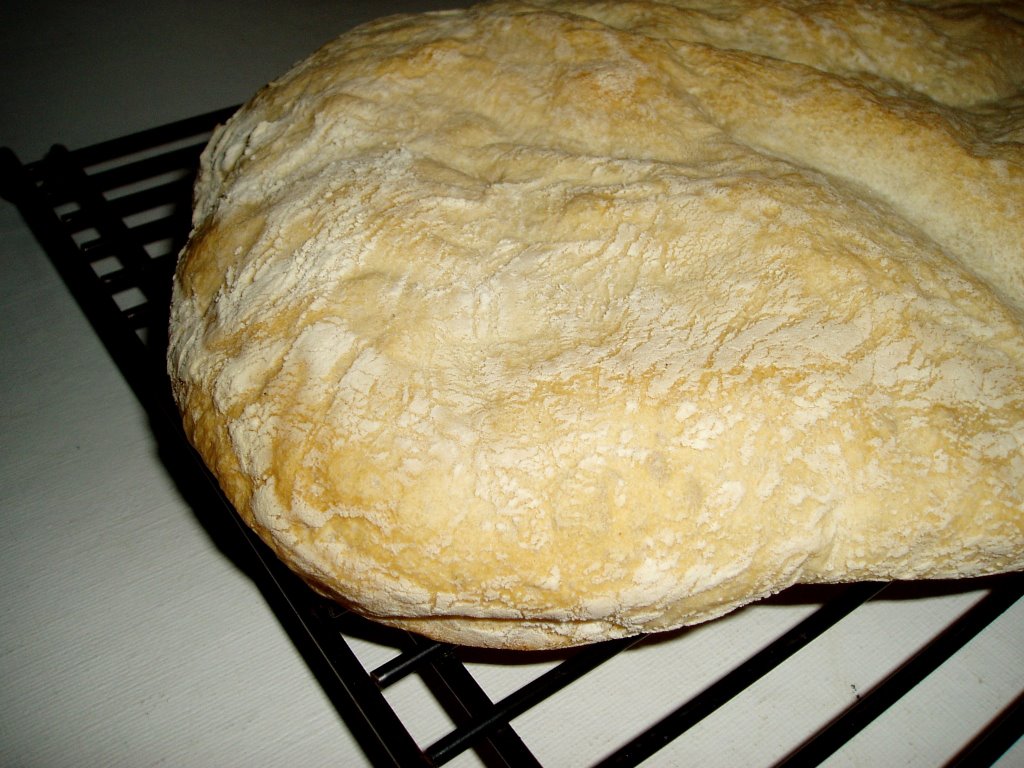
My ciabatta started out so well.
It was another of those crazy Italian very soft, wet doughs that are supposed to magically turn into the correct texture. Like the infamous focaccia. Which didn't.
But this one, made in my KitchenAid (on Speed 6, which is as fast and furious as a Tilt-A-Whirl) actually did what it was supposed to do. In just one second, it turned from a puddle into a dough.
And I could follow the directions for shaping it, too. It was soft and yet malleable, and it looked just like the picture when I was forming it into a loaf.
The problem started when I opened the oven to put it in. Usually at 475, a wave of heat blasts out of the oven, but this time it just seemed warm. I figured I must be getting inured to the heat. But when I opened the oven after 15 minutes to turn the dough around and take it off the baking sheet, I suspected a problem. The bread was not at all brown, not even beige, but I was still hoping that another ten minutes in the oven would fix it.
It didn't.
Finally I had to admit that my oven was just not working, and I had a half-baked loaf of bread. I thought of possibilities: turn the heat up as high as it would go and put the bread on the radiator; turn the hair dryer on high and blast the bread; put the bread on the clothes dryer's sweater attachment. But it was clear even to me that these were all stupid ideas.
Then I remembered that my next-door neighbors were out of town and I had a key to their house. I grabbed my baking stone, with the bread on top of it, and ran over to their house and put the bread in their oven. No time to preheat the oven for an hour. Their two cats came in the kitchen to investigate, but got bored with my project and went back to their naps.
After ten minutes, I opened the oven and looked. It was sort of tan on top, and I figured that was as good as it was going to get, so I dashed back to my house to put it on a cooling rack.
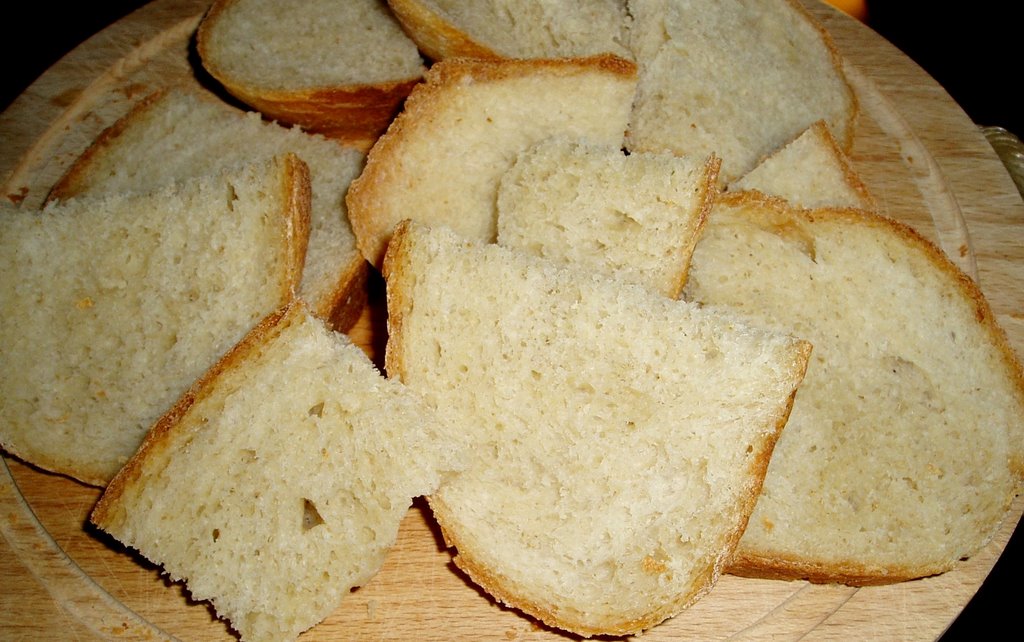
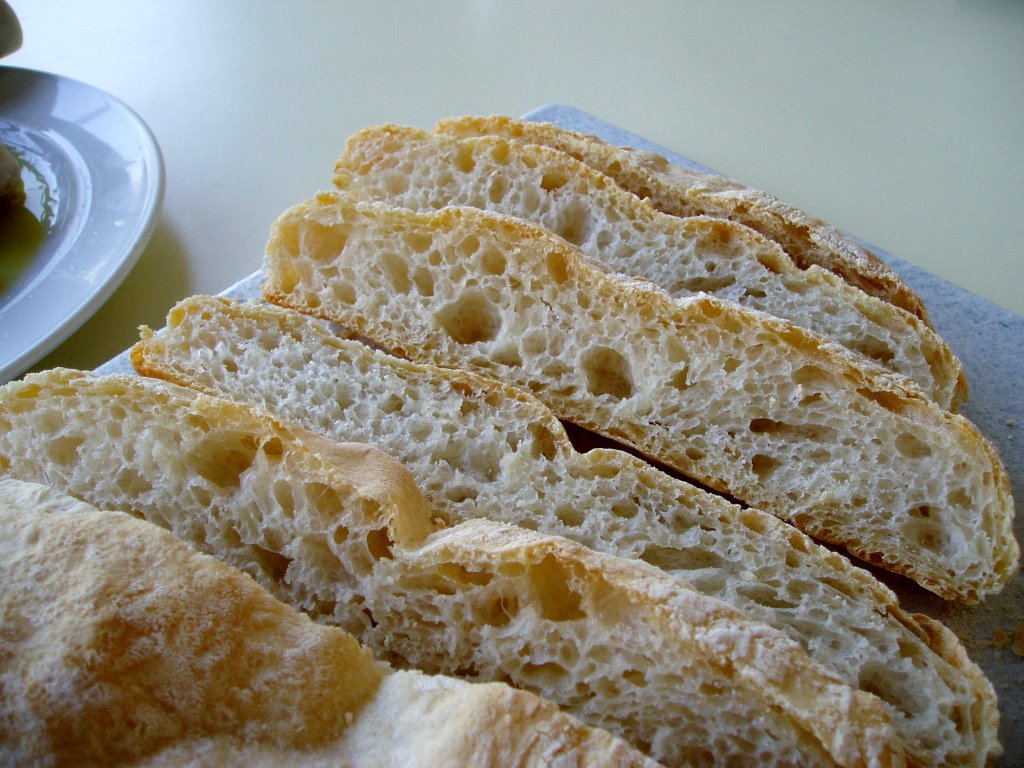
After about an hour, I decided it was time to slice it and see what this two-oven, two-house bread was going to look like on the inside. To my surprise, it wasn't that bad. It's supposed to have big holes in it. Mine had medium-sized holes, which, given the circumstances, I was happy with.

I sliced some more and served it with roasted garlic (baked before the oven went kaput). In fact, there was some conjecture at our house that the five cloves of garlic are what did the oven in.
The twice-baked ciabatta was actually quite delicious: both the bottom and top crusts were thin and crispy, and the inside of the bread was soft but with plenty of character. If I ever get a working oven, this is a bread to make over and over. The oven repair person is supposed to arrive on Monday. I just hope it can be brought back to life so that I can bake my twelve remaining breads.

Wednesday, October 04, 2006

Potato Sandwich Loaf


Wednesday, October 4, 2006

Last week Jim and I went on a whirlwind trip of New England as his birthday present. One of his life's goals is to see all 50 states, and his total had been stagnating for a while at 36. And he's not getting any younger. So he decided that he could get five states in one trip if we tooled around New England for a week. We started in Boston, then went to Maine, New Hampshire, Vermont, Connecticut, and Rhode Island, ending up on Cape Cod for a few days. Now he has only nine more states left to see.
In the midwest, we are suspicious of Easterners. We fear that they are more sophisticated than us prairie folk and that they might try to pull the wool over our eyes. No wool-pulling that I noticed, however--just very helpful people, very good food, and lots of history. Because I was in the above states over the weekend, I didn't bake my usual weekend bread. Coming back on the plane, however, the bread-baking urge came upon me, and I decided that I could bake something easy after I got home. I cooked a potato and started making this potato loaf.
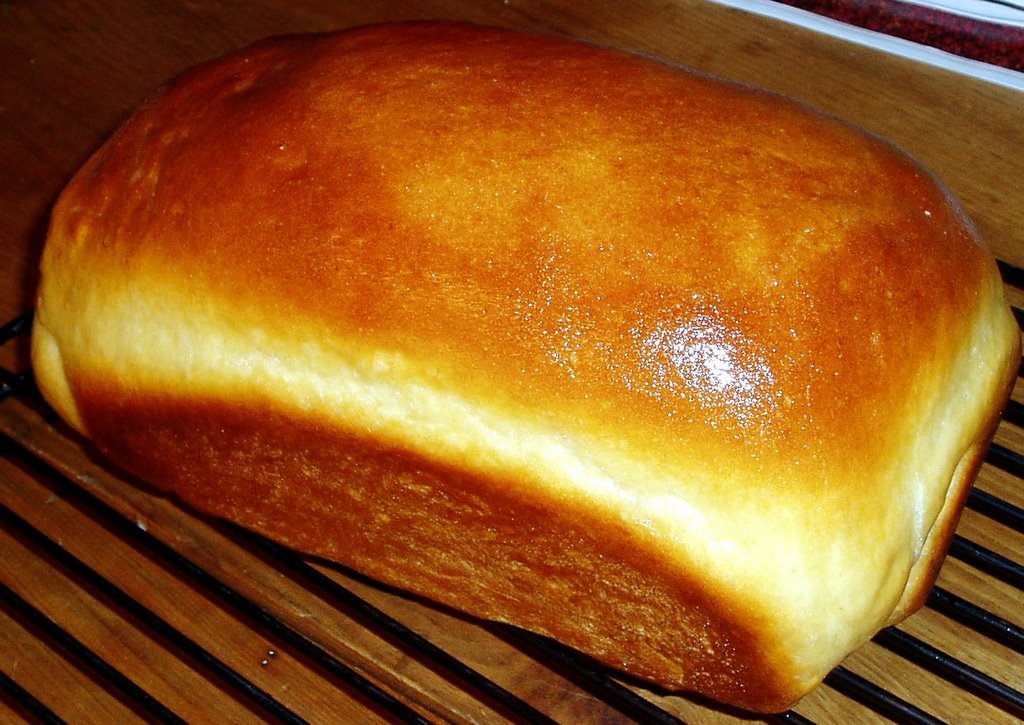
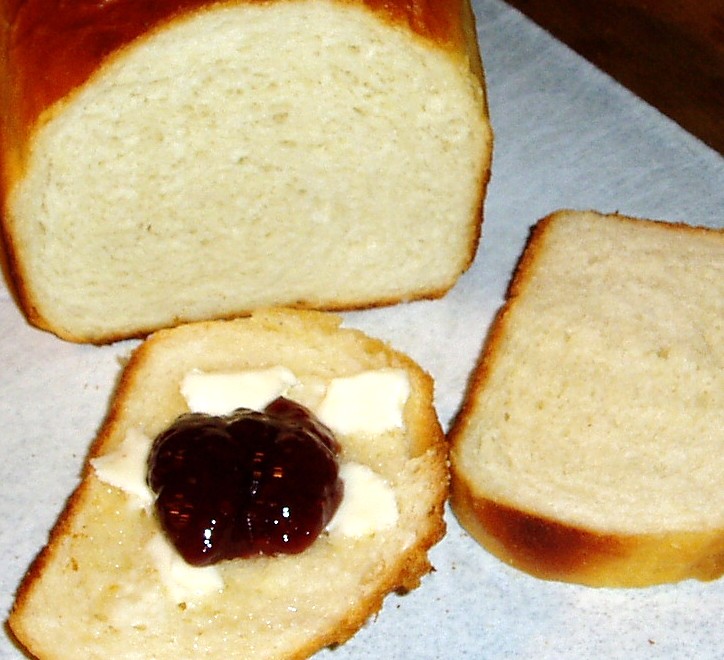
You would think that after baking bread for nine months, I wouldn't be so quick to forget that the resting and rising and resting and rising and baking parts add up to a lot of hours, but you would think wrong. I cheated a little on the last rising because I was about to fall asleep on the kitchen floor, so the loaf is a little petite, but quite edible. It's a good basic bread, with a heartier taste than the basic white sandwich loaf. I think it would make a fine meatloaf sandwich, if I only had some meatloaf, or a good egg salad sandwich, if I only had bothered to cook some eggs. It was also quite satisfying with butter and jam, which I did have.
In fact, it made me think of children's book Bread and Jam for Frances, in which Frances the badger refuses to eat anything other than bread and jam. I always liked the book, but thought that nobody would really want to exist on a steady diet of bread and jam. Eating my midnight snack last night, however, I began to have a little more empathy for her.

Saturday, September 23, 2006

Levy's Bagels


Sunday, September 24, 2006

I know, I know, I KNOW that I should always read these recipes carefully and preferably at least twice. There is often helpful, if not vital, information tucked into the middle of a paragraph. I was merrily weighing the flour when, after I'd mixed in all the flour, I realized that I wasn't supposed to add it all at once, and that the last two tablespoons were to be added only if you wanted a heavier, denser bagel "which some people like." (Implying, I think, that only people of lesser taste like it that way). Well, nothing much that can be done about it, so I continued.
After I added the tablespoon and a half of softened butter, I read Rose's comment at the end: butter will make the bagel have a softer and lighter crumb; personally, she says, I prefer them without butter. Drat! I wanted to make these just exactly like Rose likes them. Okay, I've screwed up twice, and I'm not even at the hard part yet.
Bagel dough can spend a lot of time in the refrigerator, which is good, because we had house guests this weekend, and we also went to the new Tyrone Guthrie theater on Friday night, and to see the Minnesota Opera's La Donna del Lago on Saturday night, leaving me only Sunday to shape, boil, and bake the bagels.
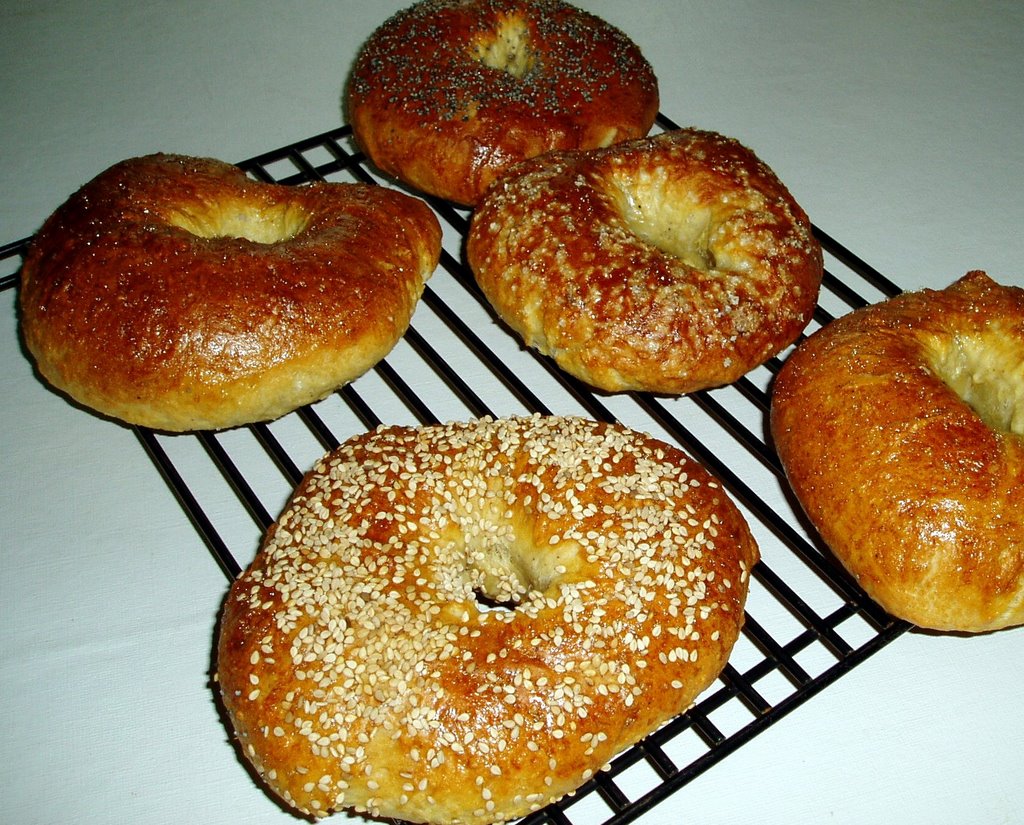
Bagels were on my list of scary breads, but they really aren't that difficult to make. The shaping gets a little tricky, and a couple of my attempts look like they were made by someone who said, "I could do that with my eyes closed." And they just looked weird when I took them out of the boiling water (with molasses and baking soda added). But after they came out of the oven, they looked gorgeous--except for the misshapen ones--with a lovely golden brown color.
We dug into them almost immediately. Because of my braces, I had to cut them in pieces before I could eat them, giving a Baby's First Bagel quality to the eating experience, but even so they were quite delicious. I was hoping they'd be good, but also hoping in a way that they wouldn't be noticeably superior to the bagels from the Bruegger's shop that's only a few blocks away, so that I would be able to tell myself it wasn't worth the trouble to make them myself. That is not the case, however. After two bites, Jim asked me if they were so difficult to make that I wouldn't be serving them routinely. When I choked at the word "routinely," he amended it to "maybe when we have company for breakfast?" I think I could handle that.

We ate the bagels with cream cheese and smoked salmon and/or cream cheese and raspberry preserves. The smoked salmon was the Minnesota kind, not New York lox, but it was good nonetheless. Good enough for a repeat. Next year.

Sunday, September 17, 2006

Kheema Paratha


Sunday, September 17, 2006
First of all, the name of this bread makes me think of Hakuna Matata, so that everything I think about making it, I start humming that song, which is one of those Disney songs that's hard to get out of your head, like It's a Small World After All, which is the very worst. So it had that strike against it.
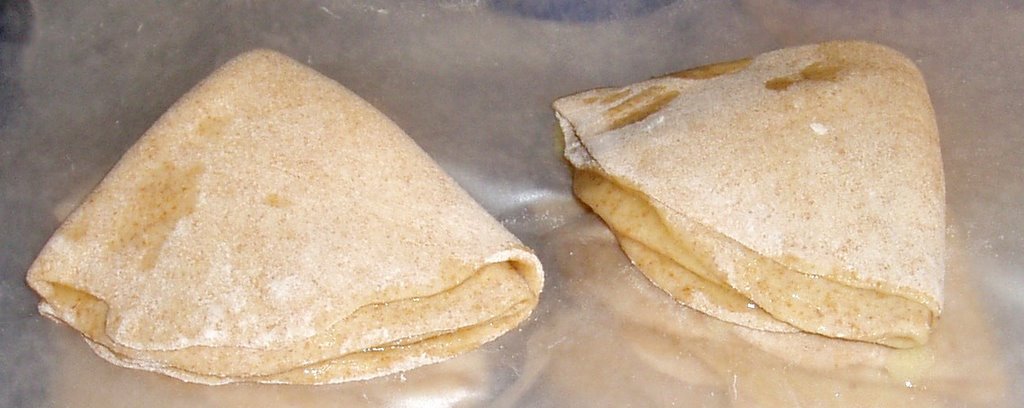
Then, just reading the directions made me tired. The dough itself is easy--just mix up half whole wheat, half white flour, add a little powdered dry milk, salt, and water, and let it rest. No yeast, no sourdough, no nothing. But then you have to cut it in eight pieces, roll each piece out in a circle, brush it with clarified butter, fold it, brush it again with clarified butter, then roll it out again, put the ground meat filling (which you've already made, and which has about 42 ingredients) on it, top it with another rolled out circle, crimp the edges, turn it over, roll it out again, then cook it in a special pan, which I don't have.

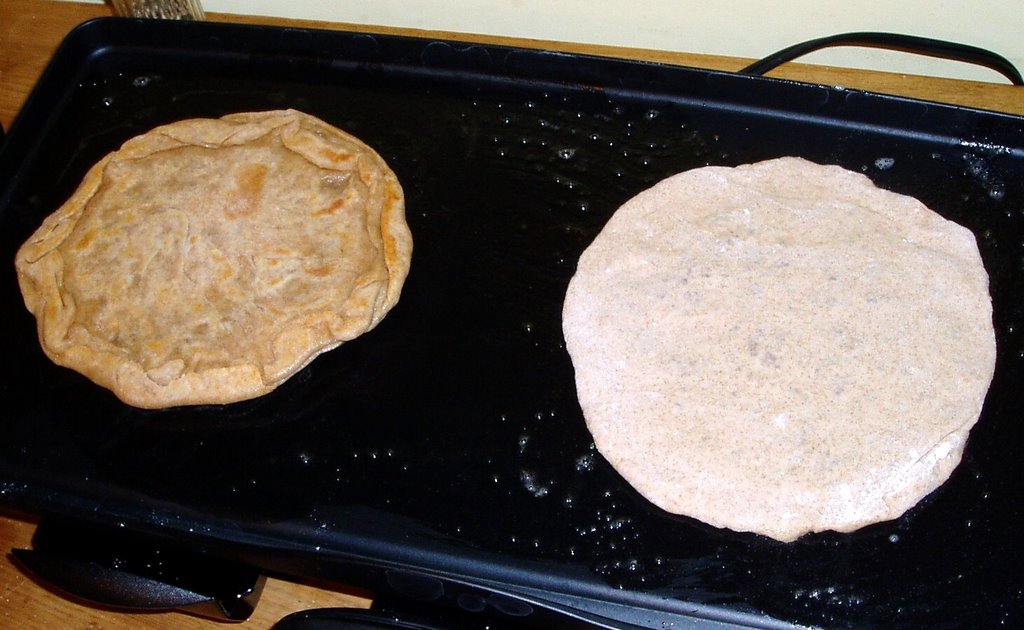
I just used my griddle that I bought to bake English muffins and crumpets, and it worked just fine.

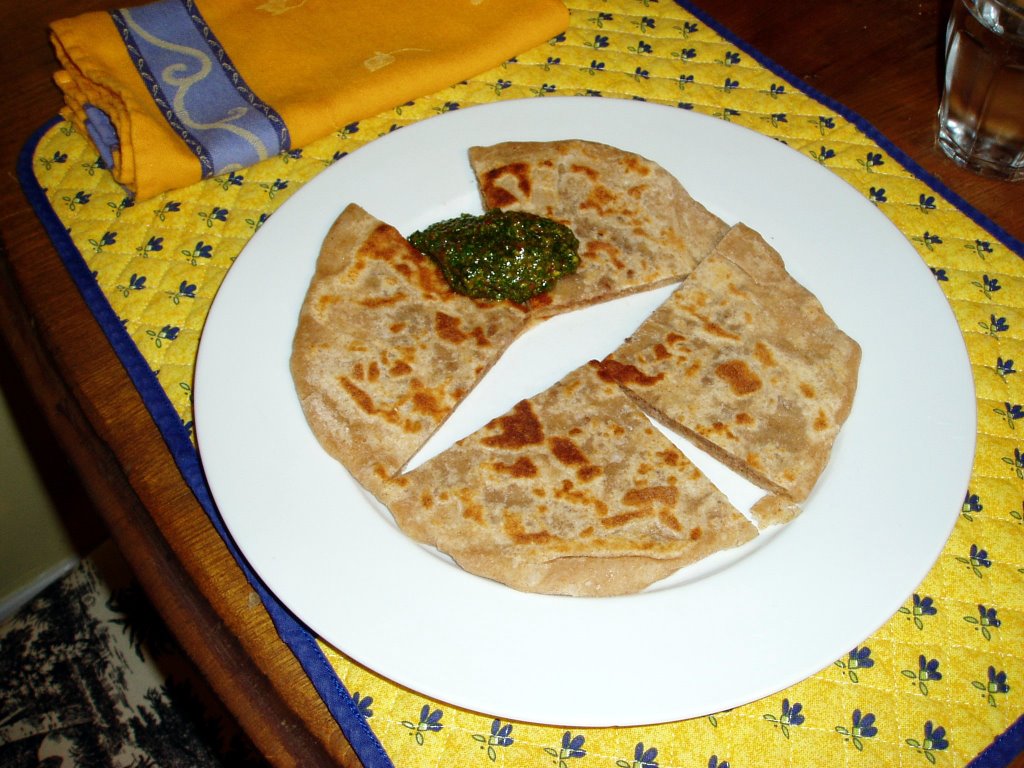
And, by the way, while the dough was resting and the ground meat filling was cooking, you make a Yemenite green sauce that has lots of cilantro, garlic, hot peppers, and olive oil.
At one point, I seriously thought I was still going to be rolling out these paratha at midnight, which would be two days in a row of late-night bread making. But, like so many things, once you get in the rhythm of it, it goes much more smoothly.
They turned out to be crazily delicious. They're a little like pita and a little like naan, but not really like either one. The ground meat filling is satisfyingly spicy, but it's flavorful, not just hot. The Yemenite green sauce, a sort of middle-Eastern pesto, is the kind of sauce that makes you think of other foods it would go with and improve.
I made four of the paratha. Jim ate two for dinner, and I ate one. I'm zealously guarding the leftover one, which I plan to have for lunch tomorrow. I feel that I'm getting fanatically food-centered. Last night I went to bed thinking about eating pumpernickel bread for breakfast, and tonight I'm going to bed thinking of kheema paratha for lunch.

Saturday, September 16, 2006

Sourdough Pumpernickel Bread


Saturday, September 16, 2006
I was in a bad mood when I started this bread, which is not a good idea because I'm pretty sure the bread dough knows when you're not treating it with appropriate respect. I believe this even though it's nonsense. First of all, the bread calls for caramel powder. Usually Rose is very good about telling you where and how to obtain products that are hard to get. But "caramel powder" is just in the list of ingredients as though it's an everyday staple. I had no idea where caramel powder would even be in a grocery store, and none of the three grocery stores I tried had it or had even heard of it.
In all fairness to Rose, after I began this diatribe, I decided I'd better go make sure that she didn't say anything about caramel powder, so I turned to the other, non-sourdough pumpernickel bread recipe, which I also haven't made, and saw a note to go to page 556, "Coloring Agents." There it says that you can use either liquid caramel, which is like burned sugar, or caramel powder, and that this is the secret to a dark, dark pumpernickel. Shit. Well, I still don't know where to get it, and this puts me in a worse mood because I know that my sourdough pumpernickel is not going to be perfect.
Also, I was annoyed because I could only find coarse-ground pumpernickel meal, instead of pumpernickel flour, which would presumably be a finer grind. This irritates me because I think it will make the bread too grainy. And I also wish I didn't have to throw away so much of my sourdough starter, which is supple and lovely after I've fed it a few times. Not to mention the fact that the bread takes six to eight hours to rise, plus another four to five after it's shaped, which means it won't be ready for cocktail hour today, even though I started on this bread yesterday morning before I went to work. In fact, I don't think it will be ready for a midnight snack. I love the sourdough breads that I've made, but I'm still not sure they're worth all the trouble.
Later.....While waiting for the bread to rise, I decide to order some better pumpernickel flour from The Baker's Catalogue. After I add it to my cart, a list of things I might want to buy since I'm buying pumpernickel flour pops up. The first thing on the list is caramel powder. I order that too and try to look on the bright side--that my second loaf of pumpernickel bread is going to be perfect.
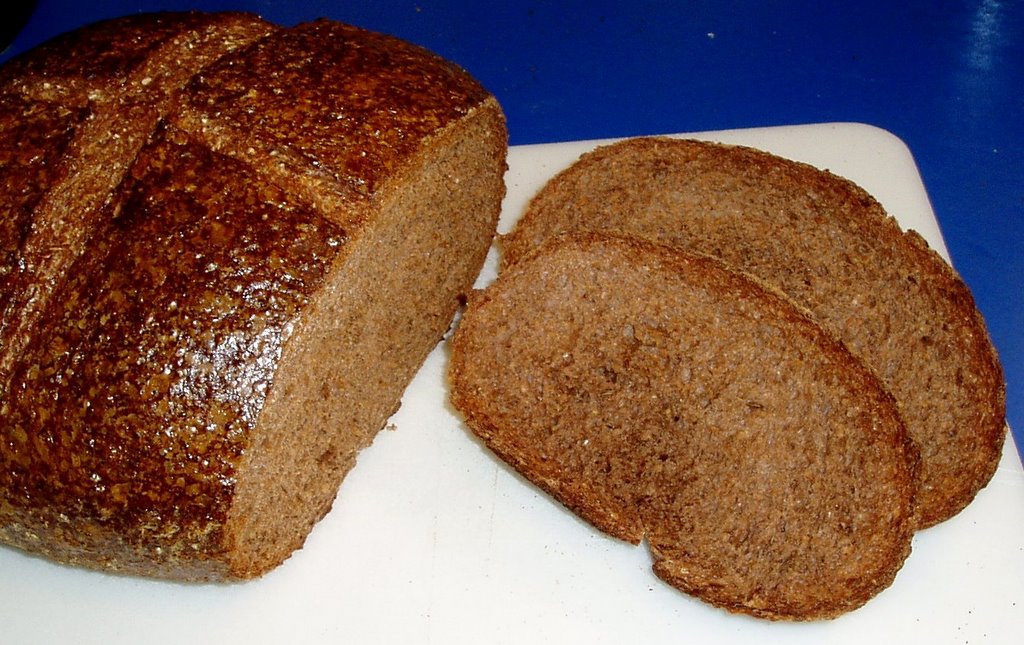
Still later.....What a great loaf of bread! Never mind that it didn't have any powdered caramel--it's still a dark, authentic-looking pumpernickel. The crust is very crisp, and the glaze (cornstarch and water) makes it exceptionally shiny. Never mind that the flour was actually meal--it wasn't too crunchy or too mealy. And it was ready for a midnight snack. It was a great midnight snack, (Jim said it's one of his favorite breads so far), and I'm looking forward to having a few slices for breakfast, along with a bowl of yogurt with slices of fresh Michigan peaches.